


Remember when the FBI was told to stand down from a counterintelligence inquiry into whether Donald Trump might be compromised by a foreign power? Add this week’s developments to the growing ledger of actions that raise the same disturbing question of whether Trump is advancing the interests of forces determined to weaken the United States and undermine the security of its allies.
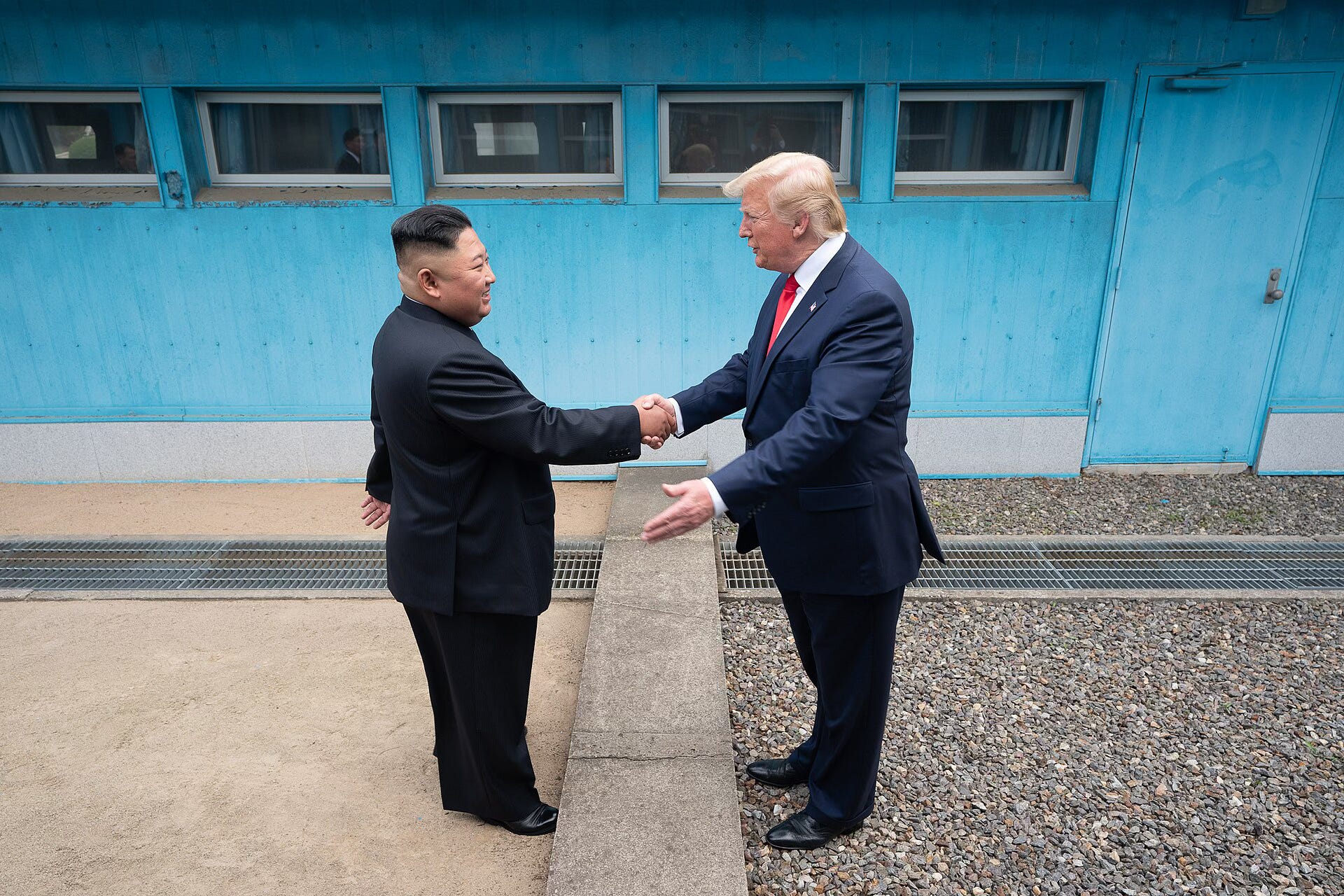
On Sunday, Trump abruptly ordered the Pentagon to “substantially reduce” the annual U.S.–South Korean Ulchi Freedom Shield military exercises, just as the drills were getting underway. He complained about their cost, attacked Seoul for refusing to participate in his Iran debacle, bragged about his personal relationship with North Korean dictator Kim Jong-un, and described exercises with South Korea as sending “a signal that is totally inappropriate and hostile” to North Korea.
Shockingly, Trump declared North Korea “unthreatening and respectful.” Really? In just the past few years, North Korea has expanded its nuclear arsenal, repeatedly threatening to use it against South Korea, which Kim has branded a “most hostile enemy.” North Korea has also deepened its alliance with the Kremlin, signing a mutual defense pact and sending troops and weapons to support Russia’s genocidal war in Ukraine.
On Monday, Trump went further still. When reporters asked why Kim had not responded to his attempts to reestablish contact, Trump said simply: “He has.” He refused to clarify the nature of the contact but added, “Kim Jong Un has always treated me with great respect. I understand him. He understands me.”
None of this should be construed as merely another example of Trump’s bizarre thirst for the approval of authoritarian strongmen. Now that he has directly impacted South Korea’s security by signaling a total end to joint military exercises in the future, the question is what led the president to effectuate this policy change — seemingly out of nowhere.
The absence of evidence for a secret deal does not make the sequence of events any less alarming. In fact, the timing of Trump’s decision makes getting answers that much more urgent.
Trump’s sudden order appears to have come without prior consultation with South Korea, even though South Korean forces comprise half of the alliance whose exercises he was ordering reduced. The directive landed as the eleven-day Ulchi Freedom Shield exercise was already beginning. It appears to have taken Trump by surprise, which means that whatever caused his decision must have happened quite recently.
These are not military pageants. By our military’s own account, Ulchi Freedom Shield is an exercise intended to strengthen combined defense posture and improve the ability of American and South Korean forces to respond together to threats. This year, it involves about 18,000 South Korean troops and is designed to include command-post training and field exercises.
That interoperability matters enormously. It ensures that American and South Korean commanders do not meet each other for the first time after North Korean missiles are already in the air. Communications systems, command structures, logistics, air defenses, and targeting procedures have to work together immediately. That only happens when militaries practice together.
Trump is reducing Ulchi Freedom Shield while insisting that the nuclear dictatorship the exercises are principally intended to deter is somehow “unthreatening.” A few months ago, I actually visited the DMZ, the most heavily militarized border in the world. The South Koreans certainly don’t believe that their neighbor to the north is “unthreatening.” Standing at the border, the immense risk to Seoul, only thirty miles away, becomes quite apparent.
The timing of all this is not coincidental. Once you connect the dots, it is impossible to ignore and it may go back to the same counterintelligence concerns the FBI had a decade ago about Trump.