



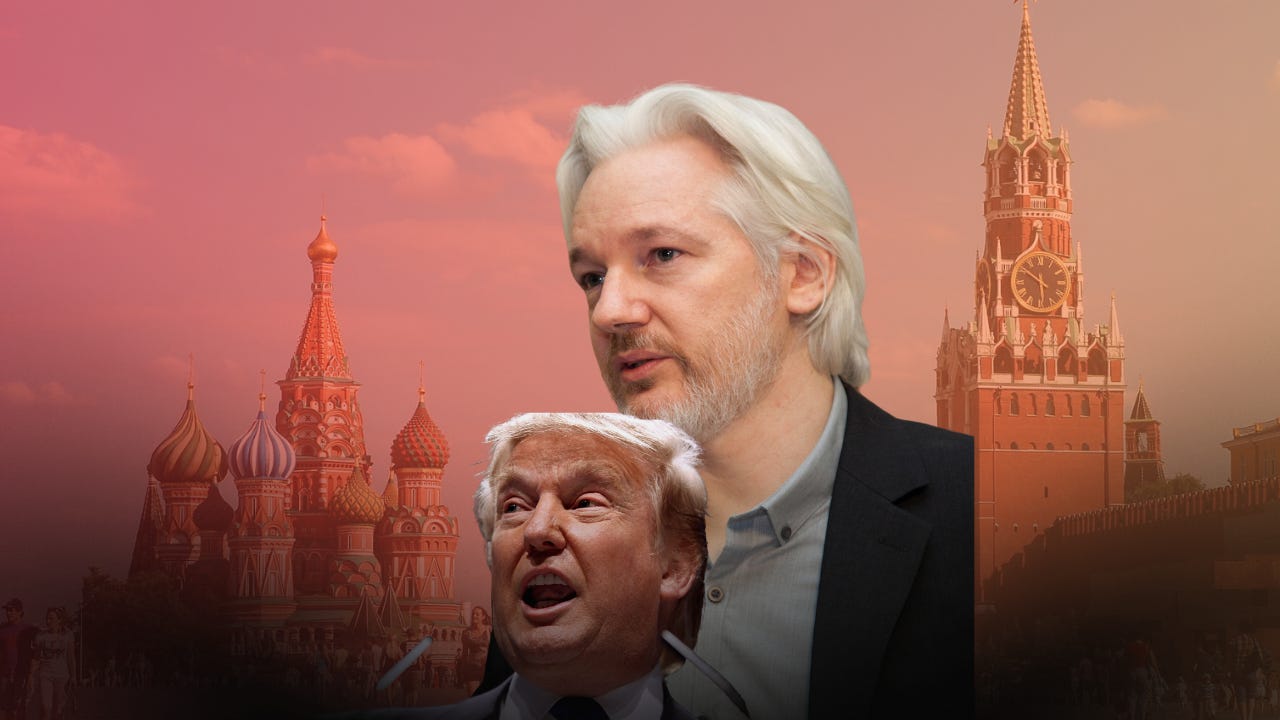
The 2016 presidential election unfolded amid a torrent of Russian information operations that blended traditional leaks, cyber-intrusions, and hyper-networked media dynamics. At the center stood WikiLeaks, an organization that had been founded a decade earlier to publish secret documents in the public interest but which was now releasing politically explosive caches stolen from the Democratic National Committee and from John Podesta, Hillary Clinton’s campaign chair. Those email dumps had outsized media and agenda-setting effects in the election season’s most compressed, high-attention windows.
The GRU, Russian military intelligence, hacked the materials and used WikiLeaks as a distribution channel. Tracing how WikiLeaks got there — and how its money, methods, media savvy, and the political ecosystem amplified its content — helps explain how Russia influenced the 2016 election to help Donald Trump win.
The Australian hacker Julian Assange positioned himself as a radical transparency activist who believed secrecy was the currency of power. In 2006, he helped launch WikiLeaks, which quickly became famous for publishing large troves of secret material, including a cache of State Department emails that shook the diplomatic world. Years before the 2016 U.S. election, Assange had already cultivated high-visibility relationships with Russian state media and with figures working in or around the post-Soviet information space. These links mapped a consistent arc: Assange had access to Russian outlets, a controversial “accredited” collaborator with deep roots in Moscow named Israel Shamir, and a shared media agenda that U.S. intelligence later described as collaboration between RT, the Kremlin’s international broadcaster, and WikiLeaks.
In January 2012, while under house arrest in Britain and fighting extradition to Sweden, where he had been charged with rape, Assange struck a deal to host a weekly talk show, The World Tomorrow, on RT. RT’s editor-in-chief and Kremlin mouthpiece, Margarita Simonyan, claimed that the program “fit” RT’s brand and declined to disclose Assange’s pay but there is no question that Assange was now on the Kremlin’s payroll, even if the disburser was RT.
The show began airing that spring. The arrangement did more than offer Assange airtime and money; it placed him inside the Kremlin’s flagship media ecosystem and aligned his profile with RT’s editorial line.
U.S. intelligence would later characterize RT as “the Kremlin’s principal international propaganda outlet” and note that the channel “actively collaborated with WikiLeaks.” Meanwhile, Assange's ties to the Kremlin kept growing. In 2013, after Edward Snowden copied and gave journalists a large cache of classified American documents, WikiLeaks sprang into action to help Snowden. Assange bragged that WikiLeaks paid for Snowden’s lodging in Hong Kong, his flight out, and offered legal support. Sarah Harrison, a WikiLeaks aide, escorted Snowden from Hong Kong to Moscow. Harrison claims she and Snowden intended to continue on to Latin America, but when that did not pan out, she stayed with Snowden in the airport’s transit zone for almost six weeks until Russia granted him temporary asylum. (Twelve years later, Snowden continues to live in Russia and became a Russian citizen after taking an “oath of allegiance” following the full-scale invasion of Ukraine.)
In August 2013, RT’s Simonyan visited Assange in the Ecuadorian embassy in London, where he was holed up and fighting extradition. The next month, RT’s Russian-language site published a story announcing that RT was “the only Russian media partner of WikiLeaks in Russia” and had “received access to new leaks of secret information.” In late 2014, Simonyan claimed she visited Assange in London again. What they discussed remains unclear, but what is certain is that Assange had spent the preceding years hurting America’s relationship with its allies by publishing leaked documents from Hillary Clinton’s State Department. It would not be the last time he would harm Clinton.
In 2015, Assange took part remotely in RT’s 10th-anniversary events in Moscow, a gala notable for the presence of Vladimir Putin and Western political figures, including Michael Flynn and Jill Stein. Secret visitor logs reviewed by The Guardian show that during June–July 2016 — just a month before WikiLeaks published the hacked DNC emails — Assange hosted multiple RT figures at the embassy in London, including RT’s London bureau chief and one of its anchors.
Simonyan was not the only Kremlin tool to visit Assange in the Ecuadorian embassy in the years after he went on RT’s payroll. Trump’s campaign chairman, Paul Manafort, who had spent the preceding years working for Kremlin-aligned interests in Ukraine, allegedly visited Assange inside the Ecuadorian embassy on multiple occasions, including in the spring of 2016 as he was joining Trump’s team as campaign manager. Manafort denied the meetings, and WikiLeaks dismissed the reports as a “hoax”, but documents from Ecuador’s intelligence service listed “Paul Manaford [sic]” among Assange’s visitors.
Then there was Wikileak’s relationship with someone who went by the name “Israel Shamir” — a shadowy Russian–Swedish writer, antisemite, and Holocaust denier. Reporting by The Guardian described Shamir as “in charge of handling Moscow cables” for WikiLeaks and noted that he invoiced the group for “journalism,” while also alleging that he served as the organization’s spokesperson or conduit in Russia. Shamir, who also went by the aliases Jöran Jermas, Adam Ermash, Izrail Schmerler, Vassili Krasevsky, Robert David, was a propagandist for Belarus and Russia while working with Assange.
WikiLeaks had first made its mark in 2010, when it published around 250,000 U.S. State Department cables that caused tremendous embarrassment for both Hillary Clinton’s State Department and foreign governments. It released the first batch of the State Department files on November 28 of that year. On November 29, Assange drafted a “letter of authority” to the Russian Consulate in London, which he signed the following day, empowering “my friend, Israel Shamir,” to drop off and collect Assange’s passport “in order to get a visa” from the Russian consulate in London. On Nov. 30, 2010 — the date of Assange’s letter asking Shamir to get him a Russian visa — Interpol issued a Red Notice seeking Assange’s arrest for the Swedish rape allegations.
Shamir later told Russian News Service radio that he had personally gotten Russia to issue a visa for Assange, but that it had come too late to get him out of the Swedish rape investigation. Russia, Shamir said, “would be one of those places where he and his organization would be comfortable operating.” In response to whether Assange had friends in the Kremlin, Shamir smiled and answered, “Let’s hope that’s the case.”
This would not be the last time that Assange would allegedly try to escape to Russia. By 2017, Assange’s connections with Moscow had grown so close that Russian diplomats discussed a secret plan to extract him from the Ecuadorian embassy in London and fly him to Moscow. The plan, described in documents obtained by The Guardian, ultimately collapsed, but it underscored how far the Kremlin was willing to go to protect a partner who had become central to its information warfare against the West.
Investigations also documented Shamir’s role handling WikiLeaks’ Russia and post-Soviet cables: he took Moscow-related cables that WikiLeaks had published, sought to sell stories to Russian outlets, and met senior officials in Belarus, where state media boasted of a “Belarus dossier.” Interfax described him as WikiLeaks’ “Russian representative.” The unredacted usage of the material risked aiding Belarus’s KGB against opposition activists. Assange later played down the relationship between himself and Shamir, saying WikiLeaks worked with many regional journalists. Still, Shamir’s efforts to get Assange to Russia immediately after the publication of the cables underscored their closeness.
In the wake of the State Department cable leaks, major payment processors, including PayPal, Visa, MasterCard, and financial intermediaries, refused to process WikiLeaks donations. WikiLeaks needed to pivot quickly in order to gain revenue.
That pivot was cryptocurrency. WikiLeaks became an early high-profile adopter, accepting Bitcoin donations and at times touting the massive appreciation of those holdings. Independent crypto trade press has estimated WikiLeaks’ very large cumulative BTC receipts over the years, underscoring how the blockade inadvertently helped bootstrap WikiLeaks’ crypto pipeline.
Whether the Kremlin or any of its cutouts used crypto to help funnel money to WikiLeaks is unclear, but there is no question that Moscow did authorize payment to Assange when RT acquired rights to broadcast Assange’s interview show, The World Tomorrow. In this way, Assange continued to profit from his relationship with Russia in the lead-up to the 2016 Clinton email leaks.
The first Russian intelligence attempt to hack into the DNC began in 2015. Russia-linked APT29 – known as “Cozy Bear” and tied to Russia’s SVR – gained access to DNC servers in the summer of 2015, just as Trump was announcing his candidacy. The second Russian unit, APT28 – known as “Fancy Bear” and tied to the GRU – arrived in April 2016. In August, the FBI notified the DNC of the breach. That fall, Russia-linked phishing attempts sent spam to Clinton’s private account in the hopes of accessing her campaign.
By mid-2016, two GRU units penetrated Democratic targets (DNC, DCCC, and senior Clinton staffers) using spearphishing and malware, exfiltrating a trove of documents and emails. The operation used online personas — “DCLeaks” and “Guccifer 2.0” — to stage and launder the releases. The Guccifer 2.0 persona reached out to WikiLeaks and transmitted encrypted instructions to access an archive of stolen DNC files in mid-July 2016. In its indictment of the GRU officers responsible, the Department of Justice later characterized WikiLeaks as encouraging both receipt and the strategic timing release of “Hillary-related” material.
Three days before the Democratic National Convention, WikiLeaks published 44,053 emails and 17,761 attachments from top DNC officials, ensuring maximum political shock just as Democrats gathered to unify after a bruising primary season. The emails showed that the DNC, which was supposed to be neutral in the Clinton-Bernie Sanders primaries, had taken action to favor Hillary. The leak was designed to create tension with Sanders supporters even as the Clinton campaign was attempting to consolidate Democratic support in advance of the November election. The DNC chair, Debbie Wasserman Schultz, resigned within 48 hours of the WikiLeaks publication, a direct and highly visible consequence of the leaks
In September of 2016, as it was leaking information to harm Hillary Clinton, WikiLeaks also reached out to Donald Trump Jr. via direct message on Twitter. In messages that lasted for months, it asked him for Trump’s tax returns, urged the Trump campaign to reject the results of the election as rigged on Election Day, and, after the election, requested that Trump demand that Australia appoint Assange as its ambassador to the United States – a move that would have presumably rewarded him for his role in helping Trump get elected.
On October 7th, the Trump Access Hollywood tape dropped, signaling a near-death knell for his campaign. Hours earlier, U.S. intelligence agencies had issued a joint statement publicly attributing the dissemination of hacked Democratic emails by WikiLeaks to “Russian-directed efforts,” warning that Moscow was conducting an ongoing attack on the American election. That very afternoon, WikiLeaks began releasing the emails it had hacked from Clinton campaign chairman John Podesta in daily batches, creating a drumbeat that dominated Twitter and repeatedly reset news cycles. The serialized approach, such as #PodestaEmails2 and #PodestaEmails3, proved algorithmically potent. Analysis of Twitter’s Trending Topics found Podesta-related hashtags trended 1,917 times and stayed on U.S. Trending lists every day in the 30 days before Election Day, a striking agenda-setting feat.
Ecuador, which had housed Assange for years, now found itself supporting a fugitive who was very much harming the campaign of a woman who could become the next president of the United States. It cut Assange’s embassy internet access on Oct. 15–16, long after the publication of the first leaks, but that made no difference. WikiLeaks’ pre-arranged contingency plans kept the releases flowing.
The DNC emails were exactly the kind of gossipy catnip that the Kremlin knew American media could not resist. They showed staffers speaking disparagingly of Sanders during the 2016 primaries and discussing tactics inconsistent with the neutrality expected out of the DNC in a primary. News organizations highlighted the most damaging highlights and internal friction. The immediate political effect, including Wasserman Schultz’s resignation at the convention’s outset, gave the leaks a dramatic arc and ensured blanket coverage. In parallel, Clinton’s campaign began publicly attributing the hack to Russia, priming the larger interference narrative that would grow throughout the fall.
The Podesta cache contained thousands of mundane campaign emails punctuated by a trickle of newsy nuggets (snippets from Clinton’s closed press Goldman Sachs talks; staff infighting; oppo tidbits) that could be repackaged into daily stories. Crucially, the format of release — daily batches with numbers and hashtags — was perfectly tuned for social media and cable programming. The timing — kicking off on the very day the Access Hollywood tape dropped — also functioned as a counter-programming tool that took attention away from Trump’s misogynistic words and reframed conversations. Though nothing in the Podesta emails was even remotely as explosive as Trump’s “grab them by the pussy” comments, the Kremlin understood that American media could not resist waiting for and covering the next dump with baited breath, just in case it revealed something salacious.
Chief among the gossip-mongers was The New York Times, the paper of record. In just six days, the Times ran as many email cover stories, derived from the GRU hack, as it did on all policy issues in the 69 days before the election. That is precisely the window when the Podesta serializations dominated. The Trump Access Hollywood tape did not receive even remotely that amount of coverage – just as the Kremlin intended.
Both The New York Times and right-leaning media and social networks served as the perfect useful idiots for this particular Kremlin operation. They formed a pipeline that could ingest a daily email morsel and re-broadcast it at scale, often with conspiratorial inflection. The effect was not merely the existence of leaks but the structured, sustained amplification across aligned outlets and social graphs.
What’s more, Assange and WikiLeaks cynically exploited the leaks to imply that they came from inside the Democratic House. In the early morning of July 10, 2016, a 27-yearold DNC staffer named Seth Rich was shot in the back in Washington, D.C.’s Bloomingdale neighborhood. From the outset, D.C. police treated the case as a likely attempted robbery – one of several in the area that summer – though no suspects were immediately identified. The Metropolitan Police Department posted its customary reward and appealed for tips.
Assange, still holed up in the Ecuadorian embassy, soon joined the fray. On August 9, he appeared on the Dutch TV program Nieuwsuur. Asked about risks to WikiLeaks’ sources, he volunteered Rich’s name and then, when pressed whether Rich was a source, said that WikiLeaks never commented on sources – a ploy to falsely insinuate that Rich had provided WikiLeaks with the DNC emails. That same day, WikiLeaks’ official accounts announced a $20,000 reward for information leading to a conviction in Rich’s murder. The bounty pushed the fringe conspiracy about Rich and the leaks into mainstream conversation, exactly as the Kremlin intended.
Later that month, Assange discussed Rich again in a Fox5 DC interview, reinforcing the idea that there was something murky about the murder and WikiLeaks’ sources while again refusing to state anything verifiable. The clip was then recycled across social media, helping churn the conspiracy further.
Assange kept promoting the Rich conspiracy even as he understood the timeline of his murder did not line up with WikiLeaks’ receipt of the emails. As he well knew, the GRU, using the “Guccifer 2.0” persona and other cutouts, provided WikiLeaks with the stolen DNC materials after Rich’s death. “Guccifer 2.0” emailed WikiLeaks an encrypted archive of DNC files on July 14, 2016 — four days after the Rich murder — and WikiLeaks acknowledged receipt before publishing on July 22. Assange’s public insinuations about Rich came while WikiLeaks was still courting the GRU cutout. In fact, WikiLeaks was working to obtain files from “Guccifer 2.0” even as Assange floated the Rich conspiracy on air and long after Rich had already died.
Whatever Assange’s role in working directly with Russian intelligence, there is no doubt that the Rich conspiracy theorywas a direct Kremlin operation, seeded by Russian foreign intelligence — the SVR — three days after Rich’s murder. An SVR “bulletin” on July 13 fabricated a lurid tale: Rich was supposedly killed by a “Clinton hit squad.” That claim was then picked up by fringe websites and, later, by Russian state-aligned online networks, forming the first traceable instance of tying Rich’s death to a political plot.
From there, the rumor migrated into the U.S. political and media ecosystem. Russian troll accounts, such as @TEN_GOP, boosted variations of the claim, while American conspiracy influencers pushed it further. By 2017, Fox News and Sean Hannity were promoting a version alleging Rich leaked the DNC emails – coverage Fox later retracted but for which Hannity never apologized. As a result, Rich’s family was battered by online harassment even as it grieved his death.
The 2016 WikiLeaks leak had all the hallmarks of a brilliant Russian active measure. It underscored how well Russian intelligence understood American media, knowing that even the dullest details in Podesta’s emails would make it to the front page of The New York Times over and over. It was understood that the Times, having served as Stalin’s useful idiots in the 1930s, could be deployed that way again. It also understood that right-wing media was so desperate to believe Clinton was at the head of a murderous cabal that it would spread the Rich conspiracy to absolve the real culprit – the Kremlin – of any wrongdoing.
Today, Julian Assange is living in freedom in his native Australia. It is unclear whether he is still in touch with the Kremlin figures with whom he swayed the 2016 election to help Trump win.
It has always smelt funny to me the way Briexit and the rise of the current US regime and crypto came together. Thanks for putting this package together.
Here is the thing with Assange. When he first appeared on the scene was a hero, he exposed the fascism in the PATRIOT Act. The Same act that created the NSA, the humongous data center at Bluffdlale, UT, that sniffs all electronic message, now with AI.
He was celebrated, then the Bush administration went after him, then then Hillary Clinton, in a fever.
So Assange saw an opportunity to wreak revenge on Hillary, by releasing her emails, and then the left did an about face without missing a beat, because it hurt their beloved Hillary.
Evidently politics is transactional, situational, and reactionary.. regardless of ideology.
And then there is Snowden, also a hero of the left, until he was persecuted and fled to Russia.
BTW I am an AOC, Bernie, progressive. A Vehement Putinophobe.