


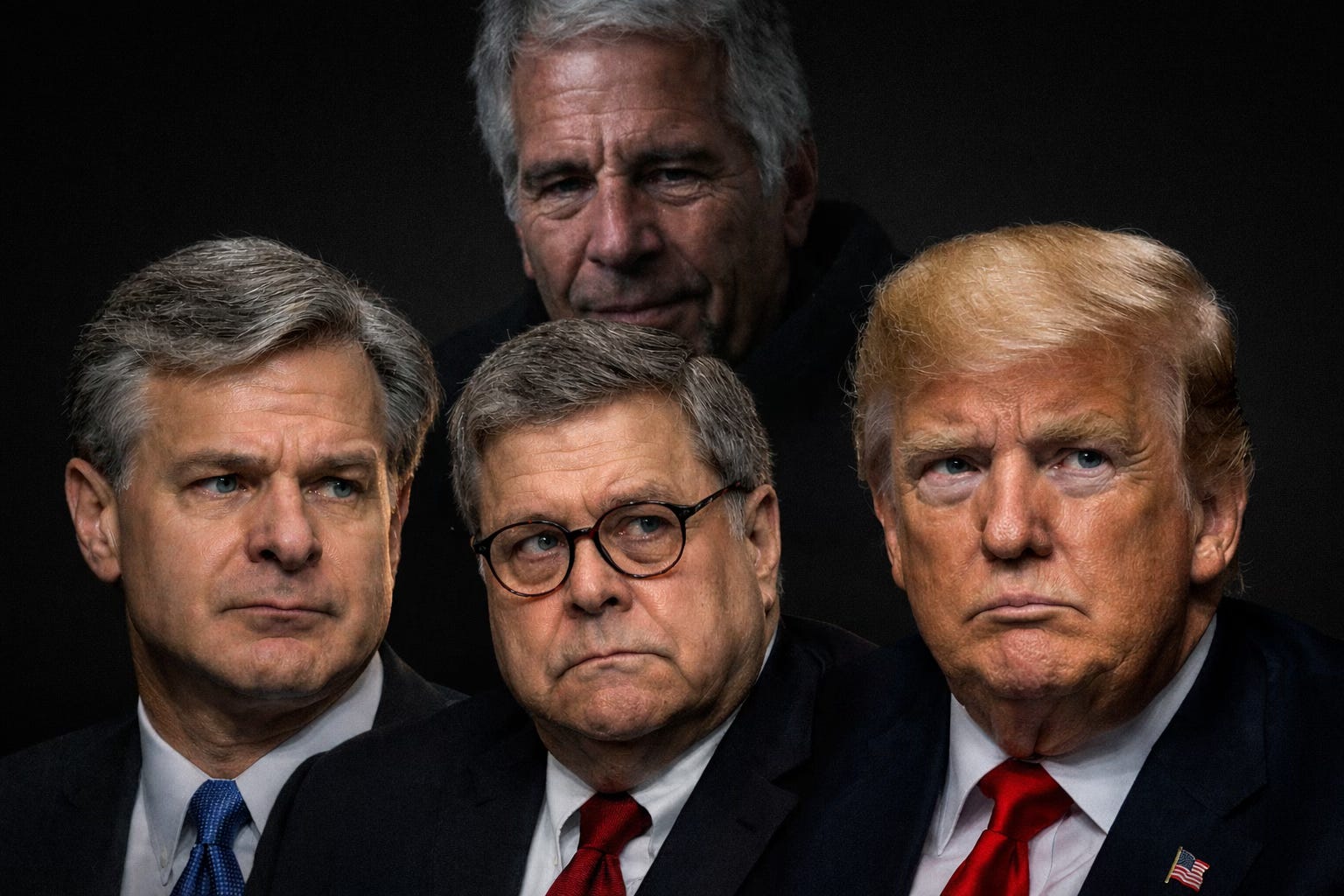
There are moments in American life when the question stops being merely “What happened?” and becomes “Who knew — and why are they still silent?”
We are there.
The latest reporting on the Epstein files makes one fact impossible to ignore: four FBI witness interview memos — the Form 302 — were generated in 2019 under the leadership of then–Attorney General Bill Barr and FBI Director Christopher Wray. The witness alleged that Donald Trump sexually assaulted her in the mid-1980s, when she was between 13 and 15 years old.
The first interview with her took place on July 24, 2019 — less than three weeks after Epstein’s arrest — and was entered into the FBI’s case file on August 9, the day before Epstein died in federal custody. In that first 302, the witness did not mention Trump. It is the only memo publicly available today.
The others are not.
Those additional interviews, conducted in August and October 2019, reportedly included far more explicit allegations, including that the girl bit down on Trump’s penis after he shoved it in her mouth and that he hit her on the head in anger before throwing her out of the room. They were conducted, memorialized, catalogued, and stored while Barr and Wray controlled the levers of federal law enforcement. Now we are being told, once again, to trust that everything important has been disclosed.
No.
The American people do not owe blind trust to the men who were running the Justice Department during one of the most politically explosive criminal investigations in modern history. Nor do we owe blind trust to those running it today.
We are owed sworn testimony.
A 302 is not social media gossip. It is the Bureau’s official record of what a witness told federal investigators. Agents draft these memos immediately after interviews. Prosecutors rely on them to assess credibility, build cases, and determine whether crimes occurred. They are the connective tissue between allegation and prosecution.
It is a federal crime to knowingly make a materially false statement to federal investigators. Whatever this witness told the FBI was serious enough to merit multiple interviews — either because FBI agents were concerned enough to pursue the claim in earnest or because they were ordered to go on a fishing expedition to see what a potential whistleblower had against the president of the United States. That alone warrants scrutiny.
But there is so much more.