



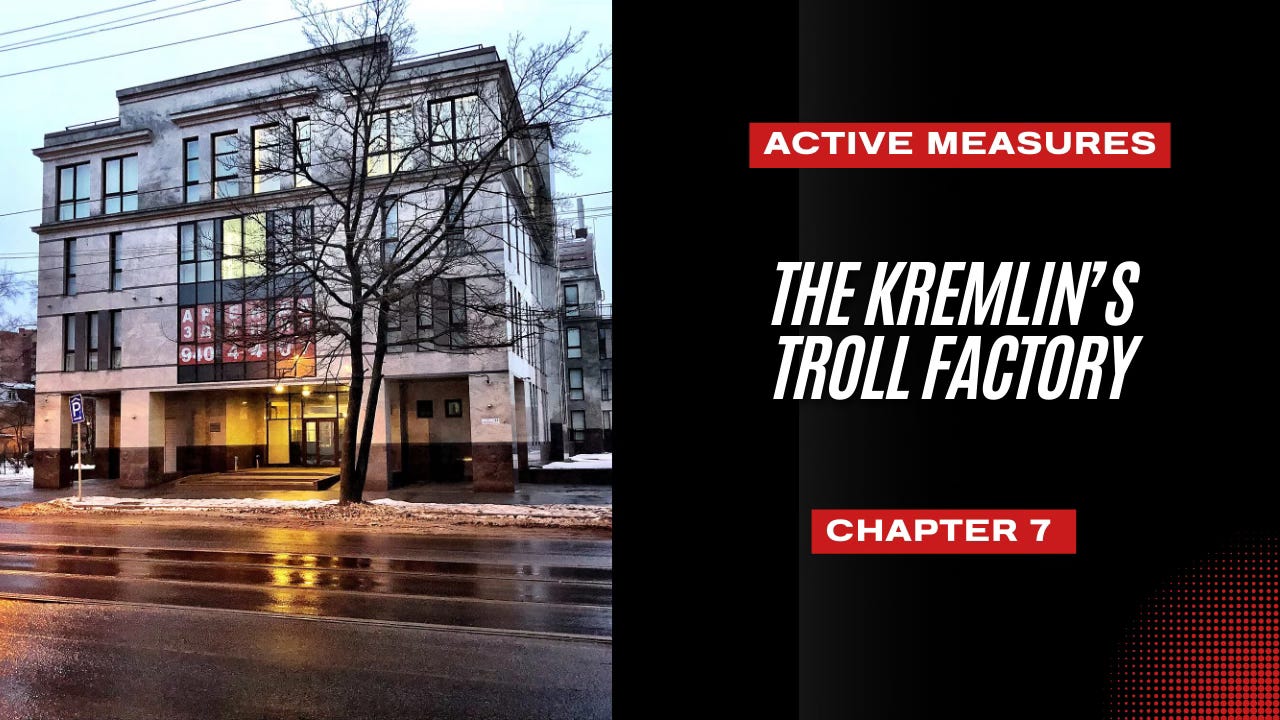
Last week, we traced how the Kremlin penetrated Fox News and the broader right-wing media ecosystem. And over the past chapters, we have returned again and again to Russia’s growing reliance on troll factories — operations whose fingerprints can be seen in the endless stream of posts, memes, and comments that flood our screens every time we log on to social media. This week, we turn to Russia’s information warfare operations and the Internet Research Agency.
The IRA was a St. Petersburg front for Russian intelligence disguised as a marketing firm, with Yevgeny Prigozhin cast as its public face in much the same way he fronted the Wagner mercenary army. In truth, neither the IRA nor Wagner was ever a private venture, and both were conceived as instruments of Russia’s hybrid war, first designed in the Kremlin itself to advance Moscow’s 2014 invasion of Ukraine while preserving the fiction of plausible deniability.
Eventually, it would be weaponized against the United States as part of Putin’s quest to elect Donald Trump to the White House in 2016.
Built in parallel, the two operations functioned as complementary armies: Wagner with its mercenaries deployed on the battlefield, the infamous “little green men,” and the IRA with its digital brigades — the “little green men” of the information space — unleashed online. Together, they served as covert shock troops, smoothing the path for Russia’s invasion, sowing confusion around the illegal annexation of Crimea, and obscuring the realities of the illegal occupation in parts of Donbas. What began as a boiler room churning out pro-Kremlin blog posts soon metastasized into one of the most consequential weapons of modern information warfare — tested first in Ukraine, then unleashed against the West, culminating in the sprawling influence campaign that targeted the 2016 U.S. election.
At first, the Kremlin regarded the internet less as an opportunity than as a threat to be domesticated. Russia’s 2008 invasion of Georgia had revealed how quickly narratives could spiral beyond Moscow’s control, and the mass anti-government protests of 2011–2012 showed just how dangerous unfiltered online organizing could be to the stability of Putin’s regime. Alarmed, Putin’s political technologists, mainly Vladislav Surkov and Vyacheslav Volodin, pressed for stricter legal controls over the digital sphere, even as they quietly tested ways to twist it to the Kremlin’s advantage. Their innovation was the so-called “web brigades,” crude teams of paid commenters who were unleashed on forums, news sites, and nascent social platforms to spam pro-government slogans, drown out dissent, and conjure the illusion of popular consensus. Putin himself, deeply suspicious of the internet’s openness, sneered that it was nothing more than a “CIA project.” To him, the job of controlling it was not optional but a matter of personal survival.
By 2013, this patchwork of experiments hardened into a more permanent strategy. The Internet Research Agency presented itself as a social media marketing firm, but in reality, it was an intelligence-directed troll farm financed through Prigozhin’s Concord Catering empire, housed in a drab building in St. Petersburg. Early whistleblowers and undercover journalists from Novaya Gazeta peeled back the curtain: recruits were required to hand over passport photocopies, submit to long twelve-hour shifts, and meet daily quotas of comments and posts. One young hire recalled being instructed to produce a hundred online messages every day extolling Kremlin policies or denouncing opposition leaders like Alexei Navalny. Another described the unnerving monotony of impersonating ordinary Russians while knowing that every word typed was part of a script designed to reinforce the state’s narrative.
The operation expanded with startling speed. By late 2013, hundreds of young linguists, copywriters, and graphic designers had been brought into its ranks, each assigned to manage multiple fake personas. Within the factory, an entire section of English-language specialists was already being trained, absorbing American slang and cultural references to make their fabricated voices more convincing abroad. Managers distributed “technical tasks” that dictated daily themes: one day to boost Moscow’s mayoral race, the next to disparage Western sanctions, the next to smear Ukraine’s new leadership after the Maidan uprising. The environment resembled an industrial assembly line, except what it manufactured was not steel or glass but a steady torrent of lies dressed up as authentic public opinion.
Ukraine As The Testing Ground
The IRA’s true initiation came in 2014, as Russia seized Crimea and ignited its covert war in Donbas. Just as Russia’s “little green men” in unmarked uniforms fanned out across the Crimean peninsula, their digital counterparts swarmed the online battlefield, flooding timelines with declarations that Crimeans had joyfully embraced “reunification” with Russia and denouncements of Kyiv’s new authorities as a fascist junta. It was the same method, applied in parallel: boots and rifles on the ground, trolls and bots online, each reinforcing the other and designed to bury the truth under a fog of contrived “legitimacy.”
On March 17, 2014, the day after Crimea’s staged “referendum” at gunpoint, IRA-linked accounts surged across social media, pumping out an endless stream of posts celebrating the supposed “democratic will of the people” — a vote carried out under military occupation. The following day, as Moscow formalized the illegal annexation, the torrent only grew louder. And when fighting broke out in Donbas weeks later, trolls flooded English-language comment sections, portraying Russian soldiers as “volunteers” and casting Ukraine as a failed, fascist state.
The most brazen test came that July, after Malaysia Airlines Flight 17 was obliterated by a Russian-supplied missile over Russian-occupied territory. Within hours, IRA accounts seeded a storm of contradictory claims: that Ukraine had fired the missile, that a Ukrainian fighter jet had been spotted, that the plane had been filled with corpses before takeoff. The numbers were staggering — more than 40,000 tweets in a single day. The objective was never to convince audiences of one version of events, but to bury the truth under a cascade of lies so relentless that reality itself seemed indiscernible. This was the “firehose of falsehood” in action: overwhelm, confuse, and drown.
Meanwhile, back in St. Petersburg, the IRA was expanding into a full-blown institution. Its original office in the Olgino suburbs gave way to a larger headquarters at 55 Savushkina Street, where hundreds labored through long shifts under strict quotas. Estimates put its monthly budget at $1.25 million by 2014, routed through Prigozhin’s Concord companies. Journalists uncovered emails showing troll performance reports being sent to Concord managers, who in turn funneled them to Kremlin handlers. In effect, the IRA became a semi-official arm of Moscow’s hybrid war in Ukraine, coordinating with GRU psychological units, amplifying RT and Sputnik, and flooding the battlefield of perception alongside artillery fire.
The success was undeniable. Trolls had muddied the waters internationally and proven that social media could be transformed into a weapon of war. Having tested their system in Ukraine, Moscow’s next step was to deploy it against the West.
Testing the West
By late 2014, Americans were already unknowingly coming across strange online hoaxes with Russian fingerprints. On September 11, trolls orchestrated a fabricated disaster at a Louisiana chemical plant. Dozens of fake Twitter accounts, doctored videos, and counterfeit news stories declared that the “Columbian Chemicals” plant in Centerville had exploded, releasing a toxic cloud. Some local outlets briefly reported it before the story collapsed under scrutiny.
The hoax was a rehearsal, a chance to gauge how coordinated personas might manipulate an American news cycle. Other tests soon followed, such as the rumors of Ebola outbreaks, lurid stories of police shootings, and exaggerated accounts of immigrant crime. Each experiment probed which anxieties spread fastest and how far panic could travel online before being debunked.
At the same time, the IRA refined its craft by constructing elaborate fake identities. One of the most notorious was “Jenna Abrams,” a supposed American blogger who mixed pop-culture commentary with provocative political takes. Abrams attracted tens of thousands of followers, was quoted by real journalists, and seemed entirely authentic — yet every tweet originated from a cubicle in St. Petersburg. Another persona, “SouthLoneStar,” masqueraded as a patriotic Texan railing against immigrants and Muslims, pushing memes designed to go viral among conservative audiences.
By 2015, the trolls had grown more ambitious. They launched phony news sites with names mimicking local outlets, churning out content that blurred fact and lies. They discovered that humor was a potent vehicle for propaganda, embedding political messages in memes that could be shared casually and spread without thinking. They zeroed in on divisive issues — race, religion, guns, immigration — always searching for culture wars percolating beneath the surface, studying which wedges cut deepest. All of it was preparation for the main event that lay ahead: the 2016 U.S. presidential election.
The Trolls Target The 2016 Election
By 2016, the Internet Research Agency had built what its managers openly called the “American Department,” a wing staffed with English speakers drilled in U.S. slang, humor, and grievances. These recruits worked from precise instructions, and, as later revealed in U.S. indictments, their mission was clear: to sow discord in the American political system, to promote Donald Trump, and to damage Hillary Clinton, all while deepening mistrust across racial, religious, and ideological lines.
As the Director of National Intelligence reported in 2017, “Russia’s goals were to undermine public faith in the U.S. democratic process, denigrate Secretary Clinton, and harm her electability and potential presidency.” Similarly, the Mueller Report concluded that the IRA’s operations “favored candidate Trump and disparaged candidate Clinton.” And finally, the bipartisan Senate Intelligence Committee, then chaired by Trump’s current Secretary of State Marco Rubio, found that “the IRA sought to influence the 2016 U.S. presidential election by harming Hillary Clinton's chances of success and supporting Donald Trump at the direction of the Kremlin.”
The center of this campaign was Facebook and Instagram. From St. Petersburg, Russian operatives built vast networks of groups and pages that posed as genuine grassroots communities, carefully engineered to span the entire political spectrum. Blacktivist, masquerading as part of the Black Lives Matter movement, drew more than 350,000 followers — outstripping the reach of official BLM pages — while being directed entirely from a troll factory. At the other extreme was Heart of Texas, which rallied 250,000 followers with calls for secession and relentless anti-Muslim bile. Other fronts followed: Being Patriotic and Secured Borders targeted conservative nationalists with pro-Trump memes and anti-immigrant propaganda, while United Muslims of America, LGBT United, and Black Matters US catered to progressive audiences, often urging them to step away from mainstream politics altogether.
Beneath the surface, a subtler offensive was unfolding. Trolls posed as Bernie Sanders supporters, later dubbed the “Bernie bots,” flooding feeds with effusive praise for Sanders while relentlessly attacking Clinton as corrupt and untrustworthy. The goal was not to help Sanders win, but to fracture the Democratic coalition and ensure that his supporters viewed Clinton with lasting suspicion. Other accounts promoted the Green Party’s Jill Stein, casting her as the only genuine progressive alternative and urging liberals to “vote Green, not for the corporate shill.” Russian state media outlets like RT reinforced these messages by giving Stein extraordinary airtime, creating a feedback loop between overt propaganda and covert troll amplification. On left-leaning pages, IRA operators also urged African Americans to boycott the election altogether, claiming that neither party cared about their communities. In swing states like Wisconsin, Michigan, and Pennsylvania, such messaging had the potential to shave off just enough votes to tilt the margins towards Trump.
Twitter provided a second front. Roughly 50,000 automated accounts linked to the IRA generated more than two million tweets about the election, pushing hashtags around Clinton’s emails, amplifying WikiLeaks content nearly 200,000 times, and retweeting fabricated stories until they trended alongside genuine news. Fake personas like Jenna Abrams and SouthLoneStar became minor celebrities, quoted by journalists and followed by politicians, their every line crafted in a St. Petersburg office. The most audacious was an account impersonating the Tennessee Republican Party, @TEN_GOP, which amassed 100,000 followers, including real political figures, before Twitter finally removed it.
Google would later uncover that the IRA operated at least 18 YouTube channels, uploading more than a thousand videos — some crude and low-quality, others dressed up to resemble grassroots news broadcasts — all designed to seep into recommended feeds. The strategy was infiltration, ensuring that divisive narratives blended seamlessly into the broad spectrum of American discourse. By Facebook’s own estimate, Russian content reached 126 million Americans — nearly half the country.
The Trolls Organize Protests
What marked 2016 as a turning point was not merely the refinement of false personas but their march from the digital sphere onto the streets. Trolls were no longer content to poison comment threads; they now sought to drive Americans into turning on one another in the streets.
One of the most brazen spectacles unfolded in Houston, where the IRA’s Heart of Texas page summoned an anti-Muslim rally outside an Islamic center, even as its fabricated United Muslims of America page called for a counter-protest to defend the same mosque. Neither group existed, yet real Texans, convinced they were answering local appeals, arrived on both sides. In Dallas, trolls engineered simultaneous “Blue Lives Matter” and “Black Lives Matter” rallies, ensuring confrontation between supporters of the police and those protesting police brutality. Other manufactured groups staged pro-Trump flash mobs, immigration protests, and even anti-Trump marches after the election — proof that the object was not loyalty to one cause but the manufacture of chaos, polarization, and disorder.
For the operators in St. Petersburg, the formula was brutal in its simplicity: radicalize online, then weaponize that energy offline. Through Facebook events and proxy bank accounts, trolls recruited unwitting activists, mailed them banners and megaphones, and orchestrated confrontations scripted from afar. U.S. investigators later calculated that Russian operatives spent roughly $100,000 on these proxy ads and protests between 2015 and 2017 — a trivial sum for chaos that echoed across the country.
In only a few years, the Kremlin had remade the IRA from a domestic propaganda mill into an expeditionary force of information warfare. What began as crude comment-spam on Russian forums had become a campaign capable of driving Americans into the streets, colliding at rallies they believed were homegrown, when in truth they were acting out a script written in the shadows of 55 Savushkina Street.
Inside the Factory
Behind the masks of fake Texans, Black activists, and suburban bloggers was a workplace that bore little resemblance to any traditional newsroom. Inside 55 Savushkina Street in St. Petersburg, the IRA functioned like a call center for propaganda. Hundreds of young recruits — many recent graduates in linguistics, journalism, or public relations — worked twelve-hour shifts, two days on, two days off, bound by contracts that required quotas and constant reporting.
Each troll was responsible for juggling several personas, often across multiple platforms. A single employee might be running a Black activist on Facebook, a conservative grandmother on Twitter, and an earnest blogger on LiveJournal, each required to post 100 comments per day. Managers handed down “technical tasks” every morning: today amplify anger about police shootings; tomorrow push memes about Clinton’s health; next week flood the zone with hashtags around WikiLeaks’ latest dump. Success was measured in engagement — likes, shares, retweets — and staff performance reviews were tallied as though they were sales numbers.
To sound authentic, trolls were encouraged to steep themselves in American culture. Some watched House of Cards to learn political jargon, others memorized slang, idioms, or sports trivia. Designers churned out viral images and memes, while analysts combed news cycles to identify fissures that could be pried wider. The effect was a kind of industrial astroturfing, where every click of outrage and viral meme was the product of an assembly line designed to mass-produce division.
Financing came through Yevgeny Prigozhin’s Concord companies under a project code-named Lakhta, which U.S. prosecutors later described as nothing less than “information warfare against the United States.” Emails and budgets leaked by Russian journalists suggested the IRA’s monthly operating costs exceeded a million dollars — an astonishing figure for what on paper was only a “marketing firm.” But the Kremlin understood it was a bargain compared to the geopolitical returns.
Exposure and Indictment
By 2017, the IRA’s fingerprints were too obvious to ignore. Journalists and academics had begun mapping its networks, and platforms were forced to admit the scale of Russian infiltration. Facebook acknowledged that troll content had reached over 126 million Americans. Twitter provided Congress with lists of thousands of IRA-linked accounts, and Google traced Russian ads across YouTube, Gmail, and search results.
The blow came in February 2018, when Special Counsel Robert Mueller indicted 13 Russian nationals and three entities, including the Internet Research Agency itself and Prigozhin’s Concord Catering. The indictment laid bare the IRA’s operations in extraordinary detail: the daily quotas, the fake personas, the explicit instruction to “use any opportunity to criticize Hillary and the rest (except Sanders and Trump — we support them).”
The United States government publicly named Prigozhin as the financier and organizer, but he was only the face of the operation. The Internet Research Agency was never a private venture — it was a GRU project dressed up as a company, overseen by the Kremlin’s Presidential Administration and backed by the FSB, with Prigozhin serving as a convenient cover.
Russia denied everything, but the exposure was damaging. Prigozhin mocked the charges, but behind the bravado his operations evolved. The IRA, crippled by sanctions and too notorious to operate openly, resurfaced in new forms. Its operatives were absorbed into media outlets disguised as news agencies, fake human-rights groups, and shadowy influence firms. The information warfare machine adapted, allowing Moscow’s war on truth to continue under new disguises.
Patriot Media Group and Its Successors
The Internet Research Agency began in 2013, with its twin RIA FAN emerging the next year as Russia moved to annex Crimea. One was hidden, while the other was out in the open, but they worked in tandem. The IRA’s trolls posed as ordinary citizens online while RIA FAN laundered their fabrications into “news,” pumping agitprop across Russian platforms and into the West. Journalists later uncovered that recruits were often hired on RIA FAN contracts while working at the troll factory — proof they were part of the same operation..
By 2015, RIA FAN had become the flagship of a growing cluster of pro-Kremlin outlets, a 24-hour mill of rewrites, memes, and timed storylines. But the success of this operation in 2016 in electing Trump led the Kremlin to double down on the tactics, which evolved throughout both his presidency and in advance of the 2024 election. When the Mueller indictments made the IRA label toxic in 2018, the model simply mutated into the Patriot Media Group, built around RIA FAN and its sister sites.
Prigozhin expanded further with the Foundation to Battle Injustice (FBR), a pseudo “human rights” project he branded the “Russian FBI,” run by Mira Terada, an influence operative and ex-convict in the U.S. who was released back to Russia. In practice, the FBR served as another arm of the troll factory, producing fabricated dossiers that accused Kremlin critics of corruption, terrorism, or ties to Western intelligence. These reports were pushed in multiple languages and aimed at domestic audiences and at Europe and the United States, where they seeped into fringe media ecosystems.
FBR’s “investigations” smeared Russian opposition leaders, NGOs such as Bellingcat, and Western governments, portraying them as agents of chaos. It also targeted Ukrainian officials and journalists with disinformation, attempting to delegitimize Kyiv abroad while painting Russia as the defender of order. Through these websites and social media campaigns, FBR laundered disinformation into the discourse of Western democracies under the veneer of “human-rights advocacy.” Abroad, the African Initiative paired propaganda with Wagner’s mercenaries, while Storm-1516 seeded fake local outlets into the U.S. information space ahead of the 2024 election. Tied to Prigozhin’s R-FBI front, the network spent more than a year pushing dozens of fabricated narratives, from viral deepfakes smearing Kamala Harris and Tim Walz to staged clips purporting to show ballots for Trump being destroyed in Pennsylvania. These efforts drew on the networks of Moscow-based American defector John Dougan, whose DC Weekly and a constellation of other fake mirror outlets posing as local U.S. news sites — The Miami Chronicle, The Boston Times, and others — served as vehicles for Kremlin narratives. Together, they aligned with the Kremlin’s sole objective: to help reinstall Donald Trump in the White House.
After Prigozhin’s mutiny and alleged death in 2023, some of the operations moved under the Social Design Agency, directed by Ilya Gambashidze under Sergei Kiriyenko, an outfit already notorious for orchestrating online influence operations in Europe and testing AI-driven propaganda tools. The same tactics remain — floods of articles, sock-puppets, fake personas — but have now been supercharged with AI and deepfakes.
The Internet Research Agency may no longer exist in name, but its model has metastasized into new structures powered by advances in AI technology and enmeshed with the Russian state. The method has remained constant: weaponize online platforms, radicalize audiences, and, when possible, push them into the streets to carry out acts of violence. What began as pro-Kremlin comment spam in Russian forums has evolved into a weapon of hybrid warfare capable of shaping politics across the globe.
As one former troll candidly explained, the mission was “to spoil it, to create an atmosphere of hate, to make it so stinky that normal people won’t want to touch it.” That, more than any single lie or meme, is the legacy of Russia’s troll factories: the deliberate poisoning of public life and discourse, carried out by a system that adapts, mutates, and endures.
The detail is impressive. Thank you for the information.
For any of you prepared to sit down for a 'long read' this article is an imperative. It goes back to Russian media bots during the taking of Crimea and also how they interfered hugely in the election of trump in 2016. Just as Mueller said they did. Americans during that election were complete patsies but don't feel bad it cost the Russians millions a month to produce this elaborate media blitz. Save it and read it because if you're like me and are interested in the machinations of the political machine, this article has it all. With receipts!